






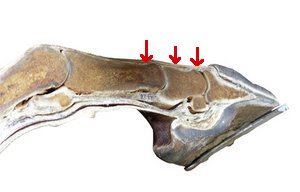
 Ringbone is actually a term to describe progressive osteoarthritis (arthritis) of the lower pastern and/or coffin joint. The arthritis forms as a result of inflammation within the joint. The body attempts to reduce the stimulus to inflammation by holding the joint still, and it does this by increasing the fibrous tissue around the jount, and then forming a bony bridge between the two bones. This condition is often seen in older horses, especially those with an athletic lifestyle.
Symptoms
Ultimately, ringbone will end in lameness for your horse. This may or may not be the first sign you observe.
Other symptoms include:
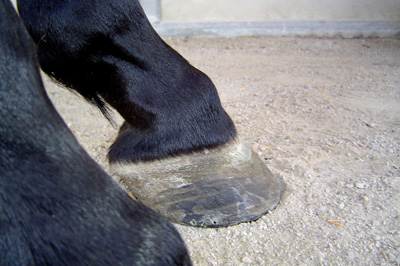
- Small spur, calcification, enlargement may be felt or be visible on the front of the joint/coronary band
- Initial brief intermittent swelling, progressing to firm, cool swelling
- In some rare cases the joint may evetually seize, which should in theory result in the lameness ceasing. The seized joint may not be noticeable walking around, but running around you may notice a stiff gait, though this varies with each individual horse.
 Diagnosis
The above may make your vet lean towards a diagnosis of ringbone, but to confirm their suspicions a more thorough examination is required. This would involve a full lameness work-up.
To properly diagnose ringbone, xrays would be required. The xrays would show the extent of the bony changes in the joint and will also confirm when and if bony union has occured.
To ensure ringbone is the cause of your horse's lameness, nerve blocks may also be required.
Treatment
Unfortunately, as for many other forms of arthritis, there is no definative cure. Where the horse is sore, palliative treatment (pain relief) may be administered by your vet. Usual arthritis treatments may provide some relief (such as pentosan etc). In some instances your vet may reccommend the case for joint-seizure surgery (known as arthrodesis), but this is usually expensive and success depends on individual factors.
Prognosis
In the short term your horse may be able to be ridden with or without painrelief, but as this is a degenerative condition, the long term prognosis is poor, and lameness will usually worsen. If your horse is a good candidate for surgery this may provide a better outlook.



Testimonials
"David and his team treat their client’s animals as if they were their own and have helped me and my horses in some very stressful situations over the years, thankfully, always with a excellent outcome!"
"Thank you so much for the extra good care you took of Lilly ... I’ve always been extremely happy with Dave as our vet, I think he truly does a wonderful job, and you can really see how much he cares.”
"The fact that Dave has been my vet for many years speaks volumes. Dave has a very nice manner and deals with the horses in a calm and kind way. He always takes time to explain options and procedures and to advise on what he considers to be the best course of treatment."
"Although we may have moved, we would not consider using any other veterinarian other than David to care for our horses."